


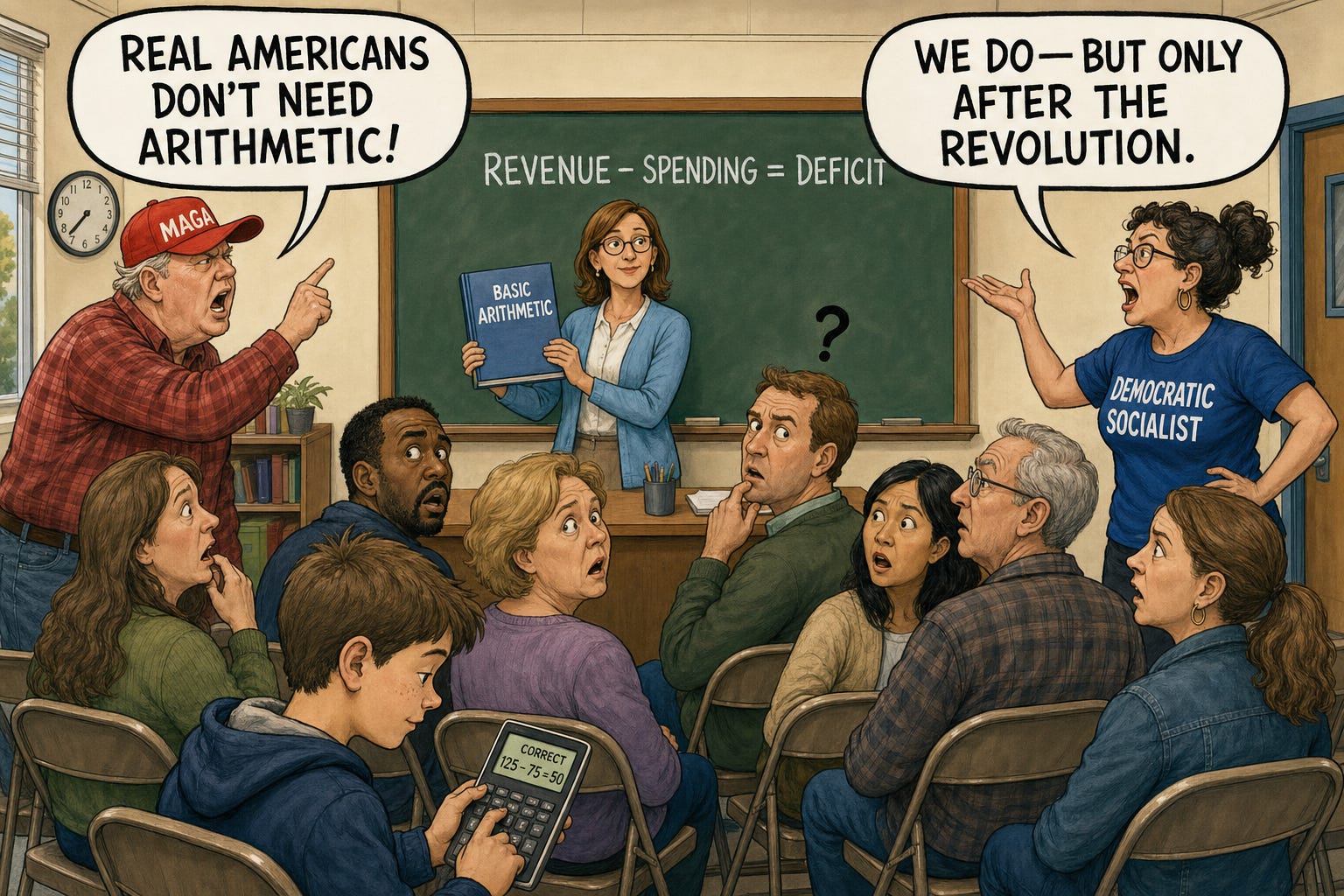
If you’re one of those people, like me, who look at numbers more than at rhetoric or soundbites, and at what government does rather than at what it claims to do, it can drive you crazy to read, hear, or watch as proponents of some new populist group or “ism” seek to capture the public’s imagination. To succeed, each of these groups seeks to win elections by defining itself as THE ALTERNATIVE to all other major choices.
As belief systems, they base much of their appeal on a claim of moral superiority. Their success requires enemies. For the right, today, welfare recipients, immigrants, and government elites are prime targets, while the left targets those with power, particularly the wealthy. They ask us to join the righteous fight while demeaning and “othering” these enemies so much that we don’t agonize over any harm we cause by attacking them.
As for sacrifice, we, their potential and actual supporters, needn’t make any. Just vote the right way and maybe participate in a political rally or demonstration here or there. That’s enough to claim self-righteousness.
Throughout history, those attempting to lead under these banners almost always refuse to do basic arithmetic. Of course, you might argue that most politicians do, too. The main difference is that “isms” tend to be more cult-like, as if some grand theory or core morality somehow justifies their incoherent strands.
Regardless, the basic accounting in income statements and balance sheets shows that every increase in spending or tax cut, sooner or later, must come from somewhere—that is, from some spending cut or tax increase. The money to spend more on childcare, health insurance, defense, subsidies to political supporters, and tax cuts must come from someone. With spending and tax subsidies at all levels of government totaling more than 40 percent of GDP, most people are contributing a fair share of their income to support government. And most are getting, or are counting on getting, a fair share in return, especially in older age.
Put another way, most people are part of the budgetary problem and part of any solution. Yet most elected officials in most developed countries greatly fear asking people to pay for what they receive. Deficits mount as spending grows faster than revenues, which means that we increasingly ask our children and grandchildren to cover the bills for the net benefits we receive today.
If they were honest with themselves, adherents to these newer cults and isms would want to address this issue. After all, how can they do anything new if they are not even willing to address the imbalances from past decisions?
Yet, what has the MAGA cult said about this? President Trump won temporary control of the federal government, in no small part, by promising to dodge this issue. He promised not to touch the unsustainable growth in government spending, largely in the Social Security and Medicare systems, which soon will be unable even to maintain existing benefit levels without new legislation. Once elected, he then succeeded in getting yet another tax cut enacted. Oh, yeah. He also attacks immigrants, IRS officials who collect taxes, and foreigners, and pretends that tariffs imposed willy-nilly do much of anything other than make us less competitive.
The Democratic Socialists seem to follow MAGA’s lead. They rarely mention ever-growing deficits, even as they promise to dramatically increase government spending that already grows faster than our national income. They definitely cannot admit that younger Americans are already required every year to transfer ever more to now-richer older Americans. Yes, they will go after the super-rich, and I suppose one can note that the rich at least have more capacity to pay than do the welfare recipients and immigrants that MAGA hates.
But even huge increases in taxes on the rich would be quite inadequate to cover the already legislated growth in existing social programs, much less pay for large new social programs, offset the tax cuts also granted to the non-rich, and address the declining revenue growth built into the system due to the growing share of the population who retire.
Perhaps you think it unfair that I lump MAGA and the Democratic Socialists together with other politicians who have brought about our current mess by denying basic arithmetic. After all, decisions made over the past several decades mean that in 2026 alone the federal government will borrow about $15,000 per household to cover the share of spending not covered by taxes. Already, about $7,500 per household goes to pay interest on all the debt accumulated by those previously in power.
But my point is simple. MAGA and the Democratic Socialists advocate major change in the nation’s trajectory, yet claim that their moral superiority justifies ignoring their own incoherent and inconsistent claims. They especially ignore the historical evidence showing the great harm caused by the isms and populists of the past.
Now, don’t get me wrong. I do think we need to change the nation’s trajectory, but only in a sustainable way. I’m not arguing against reforming welfare, immigration, or how we tax the rich. I’ve written a book about how we’ve gone way too far in abandoning the young and the working class while continually cutting taxes on capital income. You may not agree with my conclusion that we must restore the American dream by putting a greater share of government resources toward building the wealth and human capital of the many rather than the few. All I’m asking here is to watch out for those who claim that some ism provides the moral authority to espouse imaginary numbers and ignore basic arithmetic at a time when the opposite has never been needed more.
"Regardless, the basic accounting in income statements and balance sheets shows that every increase in spending or tax cut, sooner or later, must come from somewhere—that is, from some spending cut or tax increase."
That premise is incorrect. You are falling prey to the same argument many people make - that the government has to balance it's budget. That only makes sense if the entity in question doesn't print the money. Spending does not need a corresponding cut or tax increase. If the spending is for something that will stimulate the economy then the growth in the economy will more than absorb the increase in money supply.
If we really did need to balance the budget then we should have close to the same level of money supply throughout history but that is far from the case. Also, no one ever talks about where we are going to find the money for massive defense spending or tax cuts for the wealthy. What they are really doing is taking the increase in money supply from the growth of the economy and pocketing it. We should be using those funds to govern better or improve the country on things that will further facilitate economic growth (infrastructure, education, health care).
The numbers can be read many ways. Social Security, for instance, looks like a big burden on Americans because someone decided to relabel a pass-through operation as an item on the unified budget, or whatever it's called. So people come to believe that shrinking Social Security lifts a burden. But it's much more expensive to finance a retirement of uncertain length with investments than with Social Security. First, you lose a third of your investments to fees. Second, you might hit an unlucky stock market cycle. Third, if you're like most Americans, you'll have to dip into savings for current emergencies. So what looks like savings on the government balance sheet is actually more costs for the American worker. Young people are old people in training. Why would they want lower payroll taxes if it means a smaller Social Security benefit in the future? The cost of retirement won't change, and a smaller SS benefit will create a gap that more investments will have to fill. Investments are for creating familial wealth. SS is for guaranteed income throughout retirement.