


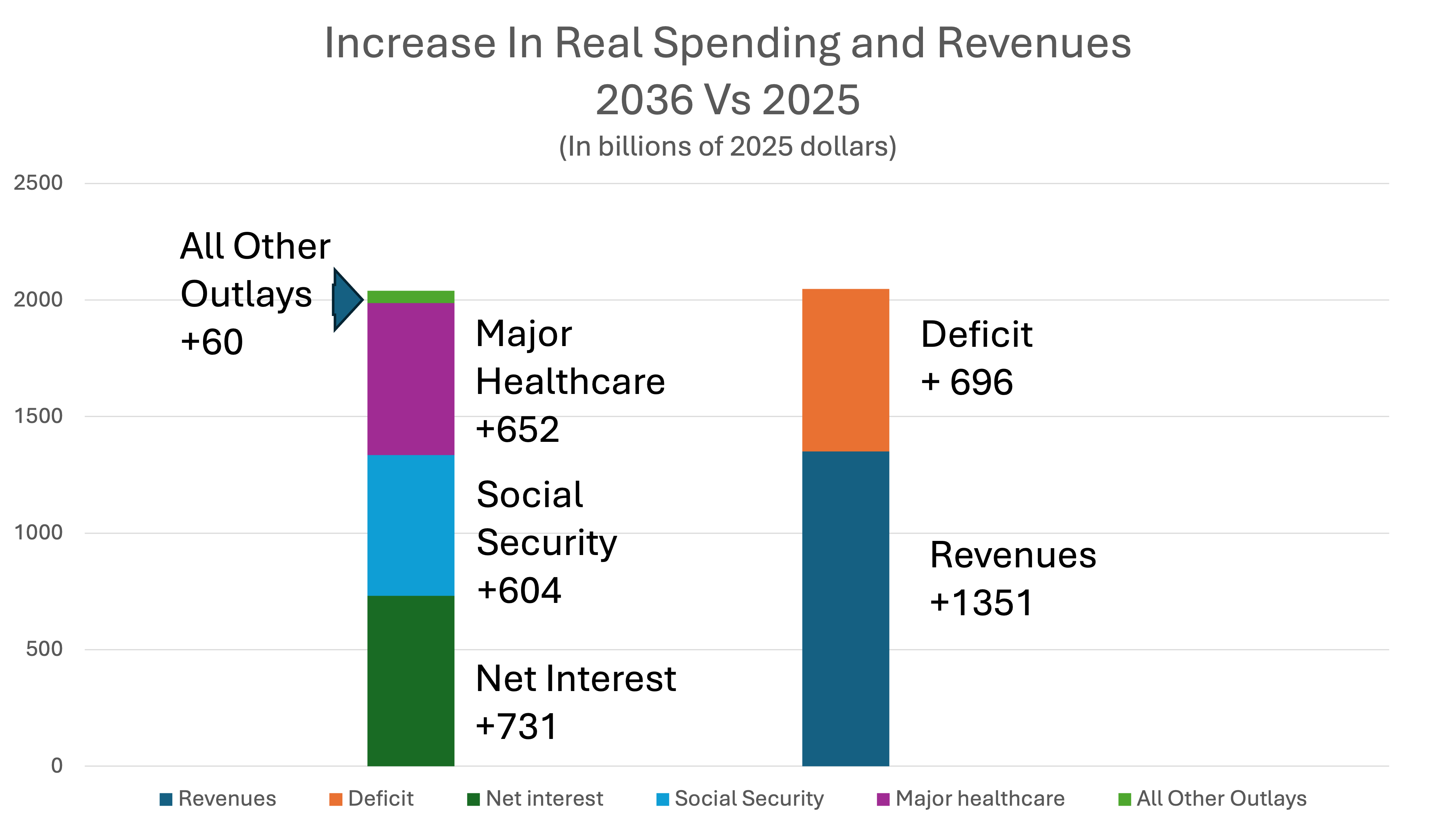
Author’s estimates, with help from ChatGPT, based on the Congressional Budget Office’s The Budget and Economic Outlook: 2026 to 2036.
For today’s column, I’m going to ask whether this picture represents your ideal for the future direction of our government. It shows how, under current law, increased real, after-inflation spending would be allocated. At the same time, it shows how it would be financed through increased borrowing and revenues made possible largely by economic growth. Our rich country makes it possible for us to do many new things. Does this reflect your priorities or that of anyone else you know of any political persuasion?
I’ll follow up in later columns, but I want you to form your own judgment first, using this simple vantage point on the path our elected officials have mandated for the nation.
We need a "fresh start," in a reorganization-type sense. All this debt came to be (as a percent of GDP) since 1980. The debt-to-GDP ratio back then was 0.3. Baby boomers have substantively lived over their heads because the politicians simply want to be in power and prosperity now is key. No one even talks about these huge problems. Watch a Congressional debate and a question about it gets a change of the subject response. The baby boomers should have to help fix this problem, instead of simply dumping on kids and grandkids. This is potential revolution-type stuff, plain and simple. If we do reorganize (and, here, as of now, I'm simply talking about writing down interest expense, not principal-yes, the markets will go haywire, but it'd be much less dire than a principal reduction reorganization that would inevitably come perhaps simultaneously with the same in other countries), we need to replace our current system (that includes two income taxes) with a simpler tax system that forces balanced budgets absent a major problem, perhaps using algebra. A VAT would make all pay some, including the baby boomers. Let's have one simpler income tax and a VAT. Make Soc Sec a part DB and part DC system, instead of the full DB system it now is. The DB part could keep people out of poverty. Create competition in health care using market forces, by introducing high deductible concepts to Medicare and only allowing tax subsidies for such plans--while tweaking the current high deductible plan definition.
I don't understand why Defense spending is omitted in the chart particularly because of the war and that a huge increase has been requested?