


In a previous note, I examined several arguments the left and the right used to justify the buildup of today’s high level of national debt. Among other weaknesses, these advocates called for fiscal stimulus without specifying how to pay for it, even in the best of times. They also discounted future costs likely to arise from higher interest rates and from the continuation of tax cuts and spending increases, whose longer-term costs they failed to account for.
Here, I want to turn to the major defect in their arguments: they paid almost no attention to ever-larger, automatic, and unsustainable deficits already built into the law.
Macro Principles of Budget Policy
Principles should guide, though not determine, budget policy. By analogy, architectural principles should guide the construction of buildings. Budget micro-principles focus on the justice and efficiency of various policies. The macro-principles—my subject here—concern what is feasible or affordable in aggregate, both in the short and long term.
Short-term. Pursue a reasonable budget balance over the economic cycle.
Long-term. Ensure long-term budget balance, in part by retaining the flexibility to meet new needs and opportunities.
These principles imply nothing more than ensuring that the numbers “add up” or balance within both a near-term and long-term income statement of receipts and expenditures.
Modern-day budget doves—those who constantly demanded more giveaways, no matter how much they drove the nation’s debt higher relative to its income—sometimes paid homage to the first principle. One way was to offset some of the spending increases and tax cuts they newly enacted, as in what is sometimes called “pay-as-you-go” legislation. Even here, many games were played, such as giving away a lot of money up front and forcing future Congresses to pass the tax increases and spending cuts needed to fund the extension of past giveaway policies, such as a child credit or business subsidy the public did not expect to be removed.
Yet they literally united in ignoring the long-term principle. A simple household analogy may help explain what happened.
Suppose a household not only spends more than its income but also has signed contracts that increase spending faster than any wage or income growth it can reasonably expect at current work levels. To start spending at an even higher rate, even temporarily, or to reduce its income by working less would only add to the mess it is in. Still, suppose a medical or other emergency arises. The household may indeed need to address that short-run emergency, but that should compel it even more to renegotiate those contracts and work to increase its income in years that extend well beyond the emergency. In aggregate, therefore, the emergency spending forces it to engage in more “deficit” cuts over time, which more than offset any short-run deficit increase.
How the Fiscal Doves Abandoned Long-term Balance
Even as Congress sometimes engaged in heated debates over some new short-term budget policy, the law it inherited from the past kept humming along, building ever-higher deficits. That law required no new legislation but mandated that many permanent spending and tax-subsidy programs keep growing. Social Security and most healthcare programs, in particular, grew steadily and automatically for decades, faster than national income and revenues. By the early 2020s, budgets had become so unsustainable that the Congressional Budget Office projected that current law, absent any reform, would require $95 trillion in spending over the next ten years, exceeding revenues of $70 trillion by about 35 percent.
Simply put, Congresses and Presidents refused to take responsibility for the deficits that were building up automatically, even as they debated new deficit legislation. The inability of the Social Security and Medicare trust funds to meet their scheduled obligations soon, even as they run ever-larger deficits each year, clearly warns of the broader problem and signals continued Congressional and Presidential abrogation of duty.
How the Fiscal Doves Also Abandoned Long-term Flexibility
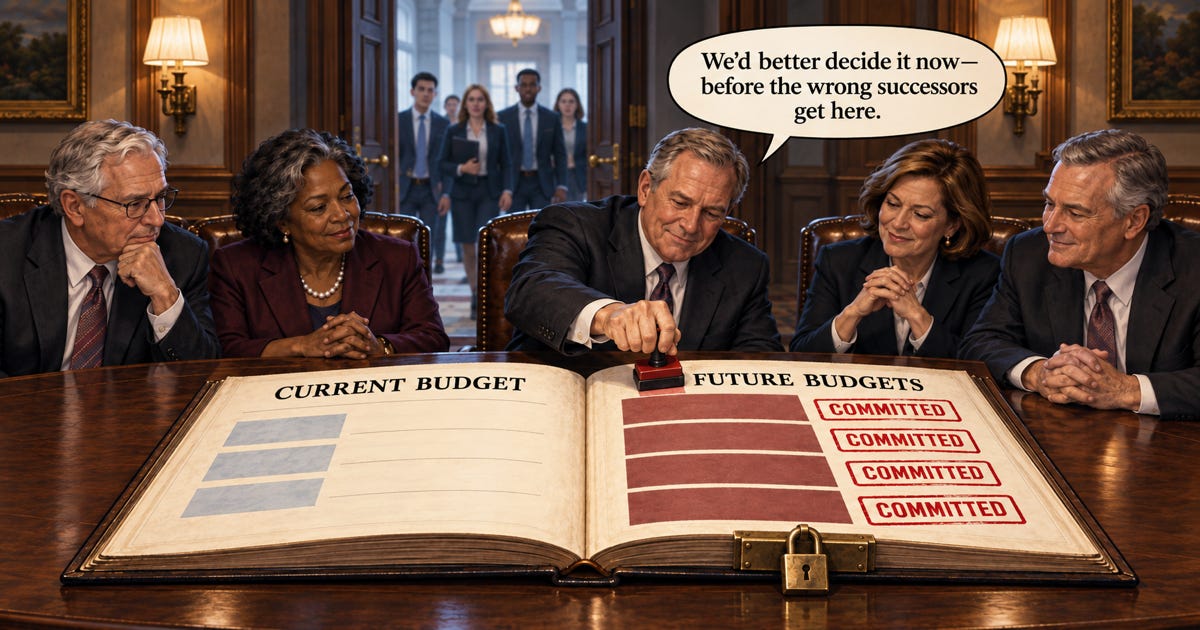
Even if current laws were somehow sustainable without new legislation, permanent programs—particularly those that entail giving away ever-larger sums of money—have increasingly eroded flexibility for future voters and their elected representatives. They create a strong legislative bias toward past priorities over current or future ones.
Modern fiscal dove economics fails in part because it assumes away the constitutional, legal, and political forces at play when government shifts from a system in which spending is almost entirely discretionary each year to one in which almost three-quarters comes from mandated, largely permanent programs that bypass the need for new legislation.
It’s not just legislators and the public who have failed to adjust. A renowned economics professor once told me that Congress could, in theory, do whatever it wanted, so only politics and a lack of courage kept the nation in its current predicament. He wasn’t a fiscal dove by any means. Still, he—indeed, many economics textbooks—has also lived in a narrow world that never heeded the second macro principle and the related psychological, political, and constitutional impediments to enacting laws that require reneging on past promises to restore any reasonable balance. Flexibility isn’t even in their equations.
Psychology tells us that taking something away from people is much harder than giving it to them. People come to expect what they have been promised for the future, whether in the form of spending or tax levels. No one expects, for instance, that Congress will suddenly yank away the Social Security benefits upon which retired older Americans have come to rely. Similarly, cutting back on promises of ever-higher healthcare benefits faces major political hurdles. People claim they are entitled to whatever high benefit or low tax level exists in current law, even when, as noted, spending exceeds revenues by 35 percent.
As a result, every time Congress meets, it finds it can address some new need or opportunity only by raising taxes on the public, cutting other spending that has become expected, or putting our debt trajectory on an even more unsustainable path.
Suppose Congress, as I do, favored making the young or the working class a higher priority. After all, by many measures, they are now poorer on average than older Americans. Or maybe it thinks we need to increase our defense spending to deal with new threats. Prior legislators, often dead now, have current legislators in a box. To achieve those goals sustainably, today’s legislators need a type of supermajority—support from both Houses of Congress and the President, or a two-thirds majority in both Houses—to both renege on past promises and then enact an alternative use of funds.
Try to think of any well-known elected official who will even admit to this problem. For that matter, how much of this do you hear in partisan or mainstream media, on social media, or in any of the campaign promises of today’s candidates for Congress? Almost all attention still focuses on today’s ridiculous cultural wars, and that distraction enables our elected officials to shirk their responsibilities to posterity.
Why blame Social Security and retirees for budget deficits? Tax cuts, pointless wars, and Wall Street bailouts are to blame. Retirement is more expensive because Americans spend more time in it, because medical breakthroughs (cataract removal, joint replacement) make it more livable, and because inflation adjustments maintain retirees' standard of living. All are social goods worth paying for.
A comparison of the US gov't to a household that's in debt, or a comparison of the nation's debt to a dead weight on the economy, or a comparison of a debt-free government to a debt-free household are not useful comparisons. Our leaders borrowed for wars, bailouts and tax cuts instead of taxing.
The result: paper asset creation and wealth inequality. Our debts are merely the reverse of the mountain of paper assets whose ownership is highly concentrated and whose value all of us are now compelled to support... or watch prices deflate. Those who own the most assets are content to let the rest of us take responsibility for a debt that's the B-side of their assets.
At the national or macro level, eliminating debt means eliminating assets. If we eliminate the financial debt, the corresponding financial assets vanish. If a world of double-entry accounting, the two are inseparable and identical in dollar-value. Most of us are not accustomed to thinking this way; we live in the micro, not the macro world.
Well, to put it another way, the contracts were signed a long time ago. So unless we're now the country/party of tearing up contracts and ignoring the law, maybe as a first step we should stop reducing the income we use to support the contracts we signed?
In your analogy, you talk about a household with a certain amount of income facing increasing costs it can't meet. You completely ignore the fact that the family unilaterally decided to reduce prices on its richest clients who don't need the contractual payments by trillions of dollars. "I cut my prices by a third and now I can't pay my bills now, boo hoo!" Nothing left to do but cut out the people who paid in to the contract and actually need it, right?
I support Social Security reform to make the system pay out what it promised, and rework it to earn market rates so that it can be sustainable. But that's fixing the system, not bankrupting it. That's the hard work lawmakers need to actually do.