


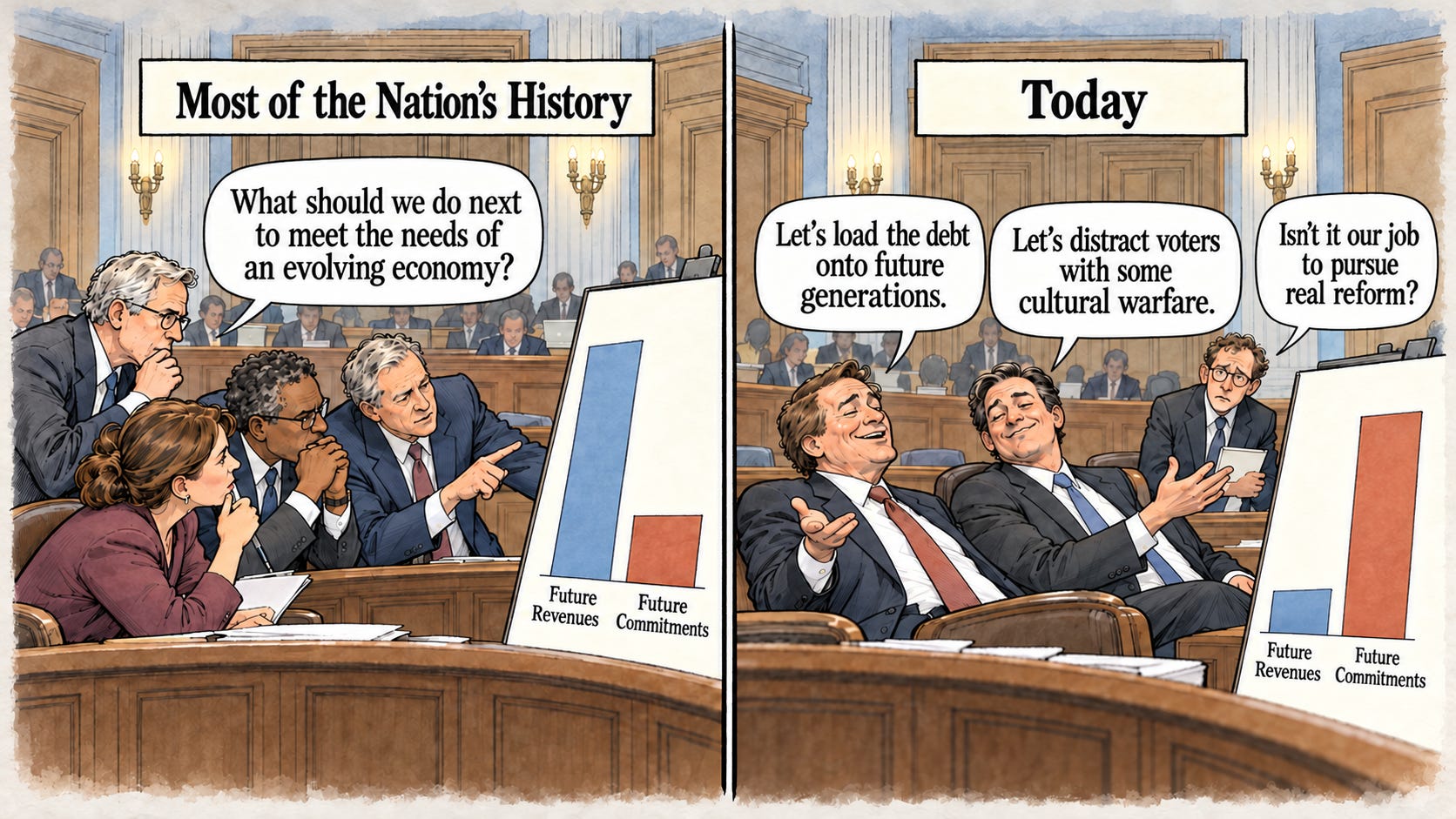
For most of this nation’s history, elected officials sought short-term balance between receipts and expenditures, with little regard for the economic cycle. At the same time, federal spending accounted for only a small fraction of the nation’s national income until the mid-20th century, so balancing federal budgets had limited economic impact. Regardless of when deficits would be covered, Washington and Jefferson were among the many of the nation’s founders who feared accumulating significant public debt. In Federalist Paper #10, Madison even called “Public Debt” “a Public curse.” While Hamilton won the day on the need for some federal public debt for the newborn nation, any new debt from war, the Louisiana Purchase, or a revenue shortfall was quickly paid off.
In his 1936 book, the renowned economist John Maynard Keynes led the intellectual and political charge to reject what he called “classical” theory and to allow government to run significant deficits in bad times. As unemployment rose and taxes fell sharply amid the Depression’s economic fallout, he argued that much higher spending would stimulate demand and help restore employment.
Although the U.S. ran higher deficits in the 1930s, including under Hoover, even Roosevelt at times tried to move toward a balanced annual budget. The Depression did not really end until the massive spending associated with the military buildup and entry into World War II. Taxes also rose significantly, with the fraction of national income not much different from today. However, they still covered only a moderate share of wartime spending. Whatever the short-term impact, those tax increases were sufficient to meet the long-term budget principle of balance.
How? Over many years, those large, permanent tax increases would far exceed the massive but temporary defense expenditures. By permanent and temporary, I mean the codified status that wartime Congresses passed on to future Congresses.
Unlike today, a sustainable long-term policy was in place then, barring future Congressional profligacy. Most importantly, aside from a small Social Security program, most spending was discretionary and had limited built-in automatic growth. Meanwhile, revenues grew steadily with the economy, especially as the broad-based income tax absorbed the same or a larger share of the nation’s income over time.
Other factors, such as failing to index the income tax for inflation, also contributed to revenue growth that accompanied the rise in national income. Meanwhile, on the spending side, defense spending declined dramatically in cycles following World War II, Korea, and Vietnam—making room for further expansions of spending policy and tax cuts over the same period.
By the mid-1970s to early 1980s, what Elliot Brownlee, a tax historian, and I have labeled an Era of Easy Finance was coming to an end, as most of the defense budget had been spent down to levels not too different from today and as Congress redesigned and indexed the income tax so that revenues would not rise with inflation. Interestingly, the nation’s debt-to-GDP ratio reached its lowest point in the entire post-World War II period in 1974, soon after President Richard Nixon declared in 1971 that he was “now a Keynesian in economics.”
U.S. politics, as well as that of almost all developed nations, has never fully adjusted to the expectations that arose in those early postwar decades. Significant new spending increases, as well as tax cuts, would no longer be fully funded by revenues that would later far exceed any committed spending level. The logic was simple: when the economy grew by, say, 3 percent in real terms, revenues would rise automatically at the same or a higher rate, whereas the then-dominant discretionary spending would increase only through new legislation. The gap could be filled with new giveaways—spending increases and tax cuts.
Since then, two dramatic legislative shifts have increasingly taken advantage of, and then increasingly eliminated, this fiscal freedom or flexibility. They have since totally dominated fiscal or budget policy. First, past Congresses scheduled spending programs, particularly Social Security and healthcare programs like Medicare and Medicaid, to grow faster than the nation’s income and revenues forever. Year after year, decade after decade, the base on which those high growth rates applied grew larger. That base also received additional legislated and permanent enhancements, such as Medicare drug benefits under George W. Bush and Exchange subsidies associated with Obamacare.
Second, Republicans decided they wanted to be the Santa of tax cuts. This became the dominant budget policy of Presidents Ronald Reagan, George W. Bush, and Donald Trump—that is, of every modern Republican President who succeeded a Democratic President. Voicing his support for this attitude, Vice President Dick Cheney once proclaimed, “Reagan proved deficits don’t matter. We won the midterms. This is our due.”
I provide this history in a bit more detail here and in much greater detail in some of my books. Now, however, I want to turn to how the logic of fiscal doves—those who consistently argue that deficits don’t matter except when the other party is in power—largely went awry. It’s simple. They applied essentially the same logic to modern legislation as they did during the Era of Easy Finance. Their fiscal arguments might still have made sense from a short-term perspective if they had decided to pay for their new initiatives at some point AND uphold the principle that long-term balance must also be restored. The latter, however, required addressing the increasingly unsustainable nature of permanent spending increases and tax cuts already in place.
At times, Congress and the President did attempt to enact new measures based on what they called a pay-as-you-go requirement. I say “attempted” because many of what were loosely called the “pay-fers” were abandoned shortly after enactment. These officials also played accounting games, such as making giveaways temporary and takeaways permanent, accepting near-term deficits that future Congresses could only avoid by letting the giveaways expire.
When recessions hit, these elected officials and their apologists acted ahistorically; they never considered that they no longer lived in the early postwar period, when revenues grew faster than spending and could cover past shortfalls without new legislation. This failure became a major driver of debt growth in the 21st century, with unprecedented, unfunded fiscal responses to the Great Recession and COVID-19 under Bush and Obama, and then Trump (first term) and Biden.
Unfortunately, this radical misinterpretation of fiscal history has not only led to today’s debt, Social Security, and Medicare crises. It has also enabled our elected officials, as they largely turned from policy to cultural warfare. Finding enemies to curse has largely distracted them from their fundamental responsibility to manage the government’s purse prudently.
It's simply amazing how the public and the press have virtually no interest in this building likely catastrophic problem. I get politicians simply want to be in power. Maybe most people think the world is going to come to an end soon, so it won't matter. I've never understood it.
Expensive wars, tax-cuts, bailouts and the dollar's reserve currency status... the U.S. took advantage of our "exorbitant privilege." Overseas exporters have been glad to take our money... if not as happy to lend it back to us. When we have to earn renminbi or euros in order to finance imports, our party will be over. But please don't hand the Republicans reasons to dismantle Social Security and Medicare. Privatized alternatives will turn out to be even more expensive--though their marketers will claim otherwise. All tax-paying workers, if they're lucky, become retirees. In their 70s, they'll appreciate the way those programs make their "golden years" less painful and anxiety-ridden.